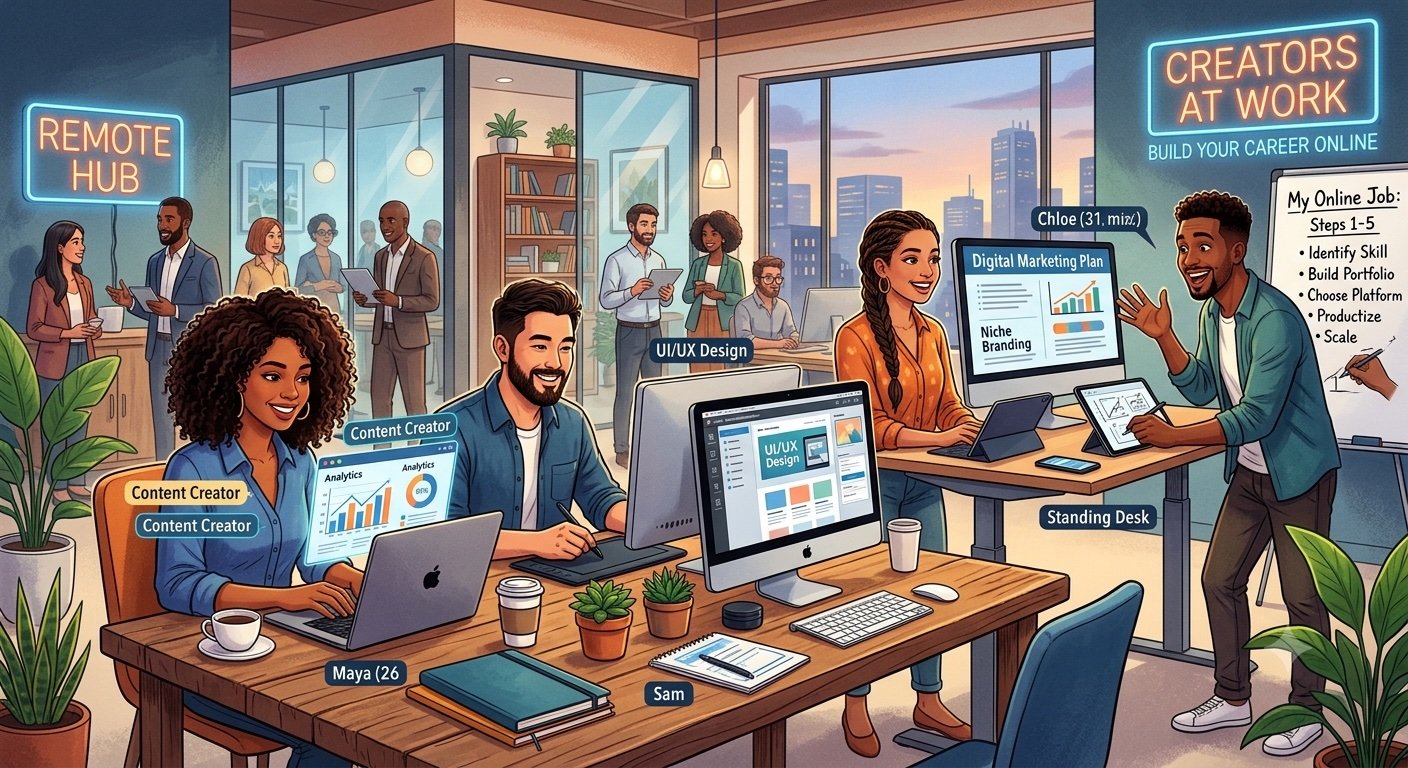
The digital economy has fundamentally shifted how we think about employment. You no longer have to wait for a company to post a vacancy, review your resume, and grant you an interview. Today, if you have an internet connection and a marketable skill, you can bypass the traditional gatekeepers entirely.
You don’t just find a job online—you create one. Here is a practical, step-by-step roadmap to building your own digital career from scratch.
1. Identify Your Monetizable Skill
Every successful online career is built on a foundation of value creation. To figure out what you can offer, look at the intersection of three things: what you are good at, what you enjoy, and what people are willing to pay for.
Common digital paths include:
- Content & Writing: Blogging, SEO copywriting, technical writing, or scriptwriting.
- Design & Media: Web design, branding, illustration, or video editing.
- Technical & Admin: Software development, data analysis, virtual assistance, or digital logistics management.
Tip: Don't try to be everything to everyone. Focus on a specific niche. Being an "SEO Writer for E-commerce Platforms" is far more lucrative than simply being a "Freelance Writer."
2. Build a Visual Proof of Competence
In the online space, a traditional resume carries less weight than a dynamic portfolio. Clients want to see what you can actually execute.
Before you pitch to a single person, build a digital home that showcases your best work. If you are a web designer, build a clean, mobile-first portfolio site. If you are a content creator, launch a professional blog or a curated LinkedIn presence. If you don't have past clients, create concepts or spec work to prove your capabilities.
3. Choose Your Ecosystem
Where you choose to set up shop depends heavily on how much control you want over your business:
- The Marketplace Route: Platforms like Upwork, Fiverr, or specialized remote job boards are great for beginners. They provide an existing pool of clients, but they take a percentage of your earnings and feature heavy competition.
- The Independent Route: Building your own brand via LinkedIn, cold emailing, or content marketing allows you to set your own rates and keep 100% of your profits. This requires more hustle upfront but offers long-term sustainability.
4. Productize Your Service
One of the fastest ways to fail online is to sell vague "hours" of your time. Instead, turn your skills into clear, predictable packages.
Instead of offering "I will do social media management for $15 an hour," offer a productized service: "I will deliver 12 optimized social media posts, 5 short-form videos, and a monthly analytics report for $400 a month." This makes it incredibly easy for a potential client to understand the exact value they are buying.
5. Automate and Scale
Once the client work starts rolling in, you will quickly hit a ceiling if you exchange all your time for money. To turn your online job into a true asset, you must build systems.
Leverage digital tools to automate your scheduling, invoicing, and client onboarding. As you grow, you can scale your income by transitioning into digital products (like e-books or templates) or by hiring other remote freelancers to help you handle the workload.
The Bottom Line: The internet has democratized work. You don't need permission to start. Find your skill, build your platform, and start solving problems for people willing to pay for solutions.